Bert's interview
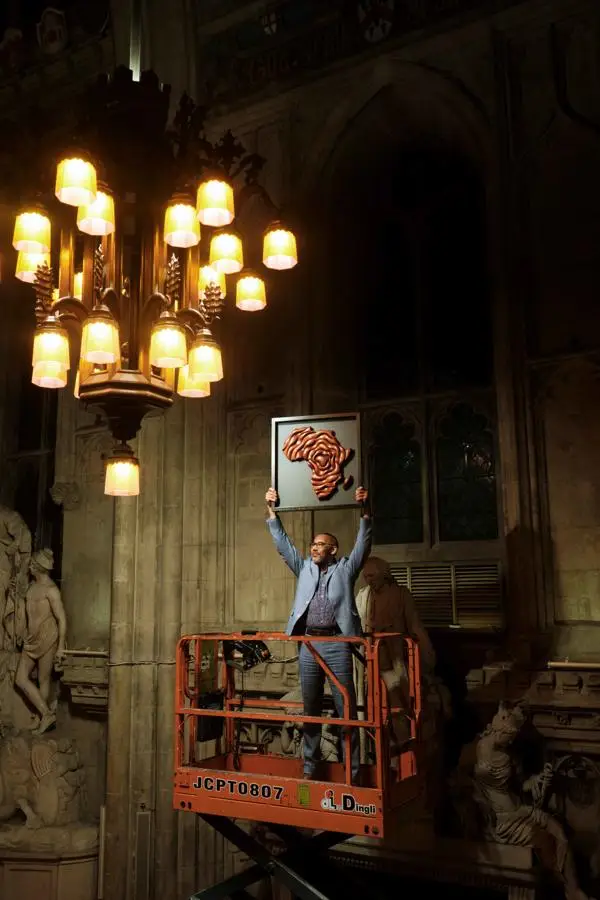
1.Why did you want to be involved in this photo shoot?
In some respects, it’s a subject that I don’t want to be associated with. But the idea of reclaiming a part of history and giving it a new narrative with the photos will make it an interesting piece, so I wanted to be a part of it.
2. How did it make you feel to be involved in this photoshoot?
First of all coming into the Guildhall itself is a very imposing space. Obviously these sculptures and statues are on high on purpose, looking down on people. I think the idea of actually going up on the scissor lift and being level or looking down at the sculpture I was photographed with, was a really good feeling. And then being able to showcase my sculptures, blurring him out, felt quite empowering.
3. What would you have liked to have said to Beckford and Cass or those who facilitated their involvement in enslaving Africans if you could have done so when they were alive?
I really thought about this question. Expletives immediately come to mind. I think most people probably have heard of the African American social reformer, abolitionist and statesman, Frederick Douglas. He wrote a letter to his former slave master before he escaped. It was called ‘I Took Nothing but What Belonged to Me’.
If I had the chance to speak to Beckford, I would recite some of Douglas’ words because his words are a lot truer and a lot stronger than any I could fathom to say.
…….
“Your wickedness and cruelty committed in this respect on your fellow-creatures, are greater than all the stripes you have laid upon my back, or theirs. It is an outrage upon the soul—a war upon the immortal spirit, and one for which you must give account at the bar of our common Father and Creator.
The responsibility which you have assumed in this regard is truly awful—and how you could stagger under it these many years is marvellous. Your mind must have become darkened, your heart hardened, your conscience seared and petrified, or you would have long since thrown off the accursed load and sought relief at the hands of a sin-forgiving God.”
Today I brought two sculptures with me to use in the photoshoot. One is called ‘Breathe’. That was done in 2020 for two reasons; my father died in 2020, and I was with him when he passed away. And also George Floyd’s death lead to the Black Lives Matter movement happening. So I wanted to actually make something that represented that movement that was going on at the time and the action of breathing and being able to breathe. This is a maquette of a larger version on exhibition in a gallery. It is just about taking your last breath, and the right to breath freely on your own terms. That is something that no one should be able to take from you. One of Frantz Fanon’s quotes, which is, “When we revolt, it's not for a particular culture. We revolt simply because for many reasons, we can no longer breathe.” I felt like I could no longer breathe in the midst of that moment in 2020 and that time is all connected through history to what these two men did.
4. Tell us about your outfit and the significance of the props that you used?
In terms of an outfit, as this was my first time in the Guildhall, I did a little Google search and it just seemed very dark. At first, I thought I would pop on a track suit and go totally against the grain but then I thought of my father, who came over during the Windrush era. I’ve got pictures of him in a suit, and I thought, well, why not wear a suit to represent him? I am wearing a very light, bright blue suit - I wanted something that would sort of uplift the photo and just bring a bit of colour to what is quite a gloomy, dark place.
In terms of the other sculpture I brought with me, it’s called ‘Making Waves – Alkebulan’, which is the original name for Africa. It's made from African mahogany, originally used in an old Victorian school. At the time the school was built, the wood would no doubt of been felled by enslaved laborers and brought to England. Being used in a school, I guess brought some joy to children playing in the gym.
I was given part of it, so I've made ‘Alkebulan’, it's a map of Africa. Its centre depicts its beating heart and a sense of movement in the ripples as you look at it, from the centre moving out. This signifies the historical and cultural impact of the African diaspora across the world. And the diverse cultural expressions from celebrations, festivals, music, dance, art, fashion, and cuisine, which have influenced communities throughout the world, not just Black communities. This is not talked about in spaces like this and I wanted it to eclipse the image of a slave trader like Beckford. I have reclaimed this wood to express the incredible contribution of the African diaspora around the world.
Both of the sculptures felt like they resonated with this space and the absence of the understanding of the history of the wealth that came into the City of London from the extraction, toil, and murder of enslaved Africans.
5. The Revealing the City's Past project is about reinterpreting these two statues in light of the fact that they are not being removed under the Government's 'retain and explain' directive. Do you think projects like this are important to you?
Yeah, 100%. The Colston statue in Bristol, which I saw after it was toppled at the M Shed museum has been reinterpreted in a horizontal position covered in graffiti. it was a good way to view it, not to have to see it up on high like most statues around Britain.
As for ‘retain and explain’, I think certainly something has to be done: I don't think you can just leave them there and just think, well, they did that, that was a bad thing, but let's move on and ignore it. As for retaining and explaining… I am certainly with the explain part, but I'm not saying that they should all remain either. I think there is a case for some to come down to be honest. The Colston statue, is down and it's never going to go back up. I think they will have to repurpose it in some way. Putting something like that back up would be saying to the communities of Bristol, formerly a major slave port, that we don't care what you think.
Today, if something goes up in the public domain, there tends to be a lot more research into their backgrounds, rather than a focus on their philanthropy to ignore the bad and honour the good off the backs of something not worthy.

6. What do you hope the City of London Corporation does next to make their spaces more relevant and accessible to more people?
That's interesting because in coming in here, it just seems like such a vast space that's so underutilised. Where we are is a huge room, and there's a huge room next door. We walked through a vast library without books. I know events and meetings happen here, but so much more could happen here for and with local communities: we're not far from Tower Hamlets and across the river, you're in Southwark. There's a lot of communities that could make use of these spaces. I understand a lot of this is listed and protected, but it almost feels a bit - them and us, and over protected. It just looks a bit barren and bare. I could just see so much more going on here. But I'd like to think that they will do more. It is a beautiful room, with lovely woodwork.
Guest interviews feature voices on topics relevant to our collections and public spaces. Guest interviews do not necessarily reflect the views of the City Corporation
Artwork ©Ayanna Sankara