Errol's interview
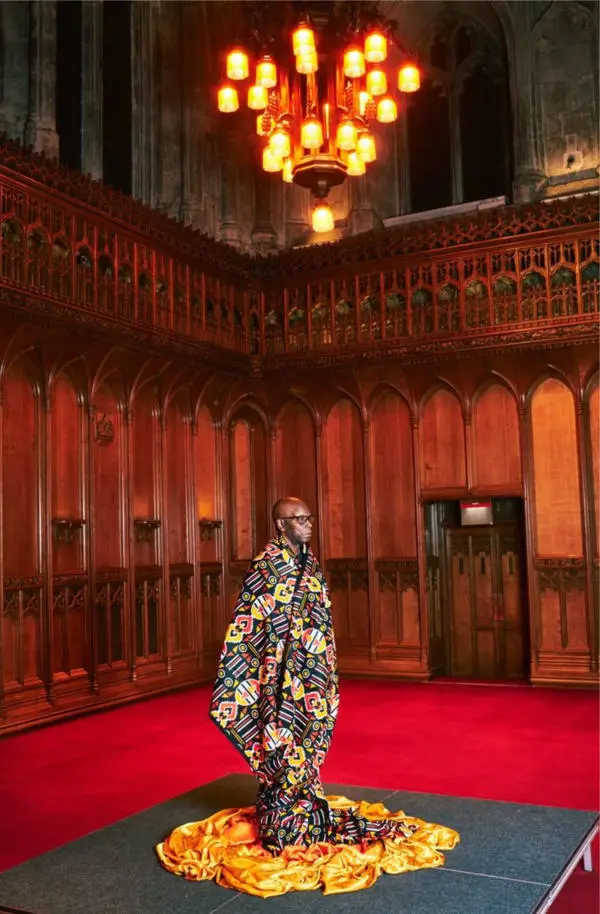
1. Why did you want to be involved in this photo shoot?
I wanted to make a statement about the presence of the descendants of enslaved people in the City of London, but also the relationship of the City of London merchants to the formation of the Royal African Company and exploitation of not only enslaved Africans, but colonial extraction in general. I wanted to do this by making a cultural statement through portraiture. I have a practice as an artist which has involved photographing myself in heritage spaces so I saw this project as part of that body of work.
2. How did it make you feel to be involved in this photoshoot?
When you ask, how did it make me feel, I would say that leading up to the photoshoot, it was the feeling of frustration and anxiety, because I felt that being photographed in front of the statues was reinscribing the importance of these people (Beckford and Cass), and I strongly believe we shouldn't be doing that, especially because originally the City of London wanted to remove the statues. Furthermore, just because there exists a ‘retain and explain’ policy, doesn't mean that we need to reinscribe the importance of these perpetrators of crimes against humanity.
Once we got the props and the approval to do it, the feeling changed to being one of satisfaction. Because I felt like I was liberated from these horrible statues - I didn't want to stand in front of them, and being able to have myself photographed in the way that I wanted it to be photographed was a satisfying feeling. Having our own photographer was also satisfying, because I was able to direct the photography in a way that I wasn't able to do with the City of London’s photographer. I think that had I not had my own photographer, I would have come away feeling like I hadn't really had much agency in or ownership of the process. When I got home, I started to visualise what we did, and I think it's a conceptual intervention, and I feel happy with it. I'm looking forward to seeing the images.
3. What would you have liked to have said to Beckford and Cass or those who facilitated their
involvement in enslaving Africans if you could have done so when they were alive?
I think that's a really bizarre question, actually, because I can't put myself back in time. I don't think Beckford and Cass are important to speak to at all. I think that this whole project has actually made me question the importance of these personalities… Beckford and Cass, whom I regard them as mediocre persons who achieved fame and fortune by exploiting other people. So, quite frankly, I don't think they're important to speak to whether in their lifetimes or after their deaths. The people that I would want to speak to are the King of England and the Prime Minister, and those now in power, institutional successors of those who enabled people like Beckford and Cass to prosper. I don't think these men, Beckford and Cass, were doing anything abnormal at the time - everyone was participating in some way in the slave economy. The really evil thing is that we had a royal family that, for example, set up the Royal African Company (the RAC) of which Cass and other City of London merchants were a part. We have, also, royal patronage of voyages of ‘discovery’ to the so-called ‘New World’ that laid the foundations and enabled enslavement. Therefore, it’s not Beckford and Cass that I have words for but those who are the institutional royal successors in our present day and who continue to benefit from the huge wealth that Britain amassed from colonialism and slavery. Then we have a network of European governments who encouraged all of this colonial exploitation. They're the ones I want to speak to – the descendants in the present royal family and government – to ask them on what moral grounds do they think that something like that should have happened and should they not now apologise and pay reparations?
In the second version of the portrait (not shown here) I’ve used two placards with words. One of them reads “the souls of Black folk live here.” That's a quotation from W. E. B. Du Bois, the African American writer. It's a paraphrase of his book of the same name that was published in 1903 when he talks about the culture of African Americans and being American, which was not readily accepted.
The reason why I’m using it is because I think the Guildhall is haunted by the memories of not only slavery and colonial trade, but a kind of ghostly presence of a history that is not visible or apparent. It's there, but it's not acknowledged. We can't see it and it's not visually represented in any way. That's why I used the phrase, “the souls of Black folk”, because it's a presence that is there, but it's not physically tangible or visible – the ‘evidence of things not seen.’
The theme, of absence, is continued on the second placard, which says “This Place is Zonging.” That's a reference to the trial of the Zong in 1783, the first trial that took place in the Guildhall around the atrocity that was committed on the slave ship, the Zong in which 132 enslaved Africans were thrown overboard by the ship's crew who then tried to claim insurance for the ‘value’ of the enslaved. So that's a reference to this haunting presence, and that's what the props meant - it's a conceptual, textural reference to history and (un)belonging.
4. Tell us about your outfit and the significance of the props that you used?
My outfit was six metres of Dutch wax, printed cloth. It was made in Holland, and is printed with African designs to be sold to the African market. It's the same style and type of fabric that contemporary artist Yinka Shonibare uses for his installations, but the pattern that I use is different to the ones they use. I think, in a way, I am taking inspiration from him because this cloth, invokes some really interesting issues about trade and culture - a product that's made for the African market but not made in Africa. The particular design that I chose also, for me, says something about modernism and the underappreciated involvement of African aesthetics in Modernism, whether we're talking about artists like Modigliani or Picasso. Abstraction actually does have an African dimension and a long history to it. I chose it because it's beautiful, and it makes these points about diaspora and cultural hybridity too.
5. The Revealing the City's Past project is about reinterpreting these two statues in light of the fact that they are not being removed under the Government's 'retain and explain' directive. Do you think projects like this are important to you?
Projects like these are not important to me anymore. This is because I think what I’ve learned from this project is that the phrase “retain and explain” doesn't just apply to the retention of the physical statue, but it applies to the explanation or interpretation as well. What this policy has done is to allow the custodians of these contested statues to determine the way that they're interpreted and in so doing constrain the validity and explanation of those with ancestral lived experience of enslavement. What I have learnt from this project is that the plaques, if they are at all to be effective, are in the wrong place. Given the institutional and royal support for the transatlantic trade in enslaved Africans, these plaques should be in the Houses of Parliament and all royal palaces to signify that the slave trade could not have taken place to the scale and extent that it did without support from these institutions.
When you got to the stage where a member of the committee in the Corporation is questioning the words that we're using in the historical texts, I think that's when you realise an acute form of censorship and control is in operation. The expert writers that we've commissioned in fact have not been entirely free to speak their mind in the way that they should have been.
It was rushed, there were poets that we wanted to engage with that weren't available at short notice, and we couldn't get them in the time because the City was imposing a shortened timeline on the process that affected the quality of the work we were able to do.. Furthermore, the design of these plaques was dominated more by planning concerns rather than artistic vision.
So I wouldn't do another project like this. I’ve learned a lot from it, it's been an interesting experience, but I wouldn't do it again. Retain and explain is really a form of cultural control and censorship that is not unacceptable – it causes further harm and injury.
6. What do you hope the City of London Corporation does next to make their spaces more relevant and accessible to more people?
I think that they've got to be much more open about the way the City of London prospered from colonialism and slavery. That's one thing. But they do have a museum - the London Museum which, by the way, could perhaps be an alternative home for these statues. I don't think that the story of how the City prospered from slavery and colonialism is currently very well told by the museum; that story has been largely exported to the London Museum Docklands as if it has only to do with docks. The new museum that's going to be in Smithfield provides a great opportunity to address the City’s colonial heritage. They need to make sure that it is accessible to all Londoners, not just its audience, but also its workers. They need to deal with the workforce there which is still overwhelmingly white. So quite frankly, this is all going to be some kind of window dressing unless they fully address these issues. They've got a perfect opportunity with the new London Museum to address colonial heritage and history, diversity of museum audiences and diversity of who works in museums. So it's up to them really about whether they take up that challenge.
Guest interviews feature voices on topics relevant to our collections and public spaces. Guest interviews do not necessarily reflect the views of the City Corporation.
Artwork ©Ayanna Sankara