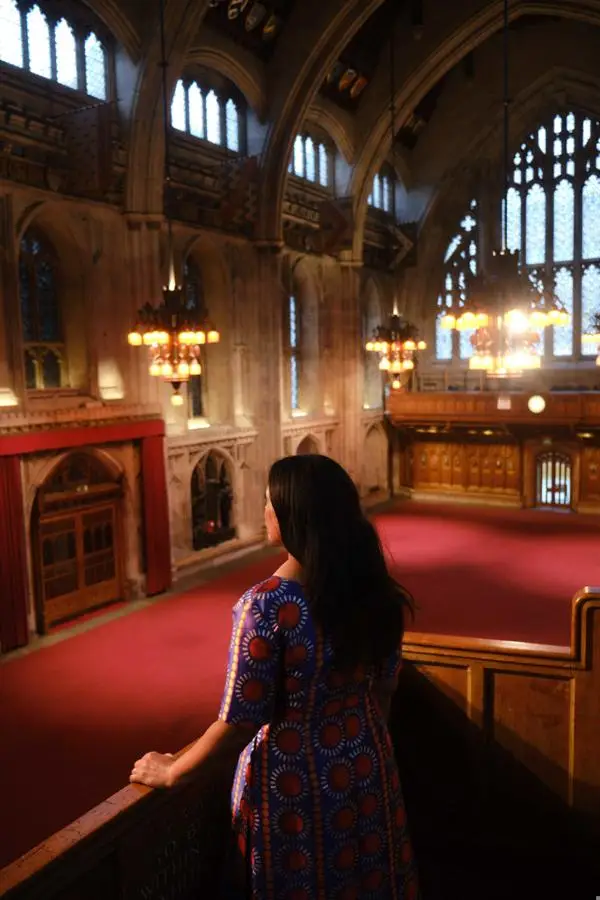
Acres of regal red carpet signify the wealth and gothic grandeur of the 15th century Guildhall. Its walls are flanked with statues, commemorating those considered worthy of being immortalised and its windows flaunt panels of stained glass, which glisten as if made from the sugariest hard- boiled sweets. There is a palpable stillness like a library, a place of worship or a graveyard. This space was designed to reflect the’ power of London and its leaders,1 and therefore it is no coincidence that all of them are white and male.
However, if you look very closely, you can see and hear the indistinct voices of women and the almost silent voices of Black women. For example, at William Beckford’s feet sit two allegorical female figures, William Pitt the Elder is similarly adorned with the white female form and the stained glass windows reveal the names of 700 Lord Mayors, only two of which were women. The voices of Black women are more muted still. Their names, though often not those given at birth, can only be traced today if they came into conflict with the official judicial system. This recorded such ‘crimes’ as, ‘missing’ female servants who asserted their freedom rather than waiting for it to be conferred, miscreants so hungry they had stolen butter, or prostitutes, a ‘crime’ so congruent with the dominant construct of the libidinous Black women, it hardly raised an eyebrow2.
However, the loudest voices are the 543 unnamed enslaved Black women and children who were thrown overboard from the cabin windows of the Zong on 29th November 1781. On this, the first of three rounds of killings, before the ship reached Jamaica, only the least valuable; the women and children, were murdered. Their voices rebound from the very fabric of the Guildhall where the trial, which was pivotal to the abolition of slavery, took place. Although no member of the crew was tried for murder, these unnamed Black women and children claim their place in history as a critical part of the abolition narrative.
In re-examining the involvement of Beckford and Cass in the Transatlantic Trade in Enslaved Africans, we were mindful not to perpetuate the epistemic and archival violence of Black women that enabled their lives to be literally worth- less. Or for their voices to be so faint, they were inaudible. Therefore, the project team intentionally brought Black female writers, academics, poets, artists, project managers, graphic designers, advisory groups and vocal artists together to provide a complex, nuanced, intersectional reading not only of the statues themselves but the institutions and systems that they were a part of.
The Guildhall is by no means the only public space where monumentality pays homage to white male aesthetics4 and in this sense this serves as a case study of all such spaces, as we look with fresh eyes at who we choose to memorialise and how.
Guest blogs feature voices on topics relevant to our collections and public spaces. Guest blogs do not necessarily reflect the views of the City Corporation.