Making Patterns by Ayanna Sankara
Making Patterns and Hopefully, Breaking Patterns (2024)
A Design Inspired by Black Caribbean History and the African Diaspora
by Ayanna Sankara
I was commissioned to create a pattern that would create a welcoming space online , evocative of the Caribbean and including West African symbology for the webpages of the Revealing the City’s Past project. I’m hoping the pattern will help people, whose family histories are intertwined with the statues in Guildhall, feel acknowledged, rather than erased and ignored as they might have in the past. I’m a Graphic Designer who is grateful to have been offered the opportunity to dive into my history through a medium I love, design, which is why I was drawn to this project. I researched and experimented with designs to end up with one that people hopefully can connect with especially people of a Caribbean background like myself. that people hopefully can connect with especially people of a Caribbean background like myself.
Creating this pattern was an enjoyable and winding path to completion. I was glad to be chosen and enthusiastic about getting started, but overwhelmed by the many symbols and the concepts that could be imbued in this design relating to the narrative of African Caribbeans. My knowledge of West African and Caribbean symbology was and is far from extensive, but having a small library of books in my home that centred around Black culture in its varying forms, including a few on African symbology, helped me begin deepening my understanding… thank you Mom!
This project was a welcomed opportunity to research and learn more about African visual communication, create a colourful pattern inspired by my ancestry and be part of a project that emphasises the full story behind William Beckford and John Cass’ statues at the Guildhall . Coincidentally, Beckford is one of my family names, adding to my motivation to create a pattern that centres the story of the African and Caribbean people affected by these people’s actions who have been praised and immortalised at the City of London.
I’ve learnt so much about West African and Caribbean symbology throughout the process of creating this pattern. I learnt about Nsibidi, an ancient graphic communication system, more about Adinkra symbols, Kente cloth symbols, Adire and Bogolan Mudcloth. How Madras, a strong cotton fabric with colourful stripes or checks, with Indian origins and popular in Caribbean national dress), was used on many Caribbean islands, as a form of expression and that trees can represent self-sufficiency and resourcefulness, and that their importance in the Caribbean culture is arguably understated.
Symbol meanings
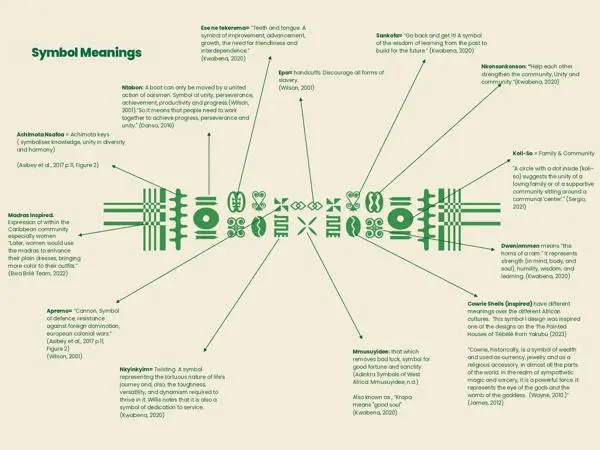
During the process of creating this pattern, I took inspiration from artists and designers such as Yinka Ilori, known for his use of shape and way of making his designs feel joyful inspired by his Nigerian heritage and Althea McNish, for her ability to create unique patterns with a variety of auras often inspired by her native Trinidad.
My initial intentions were to visually tell a story that's open to interpretation. The pattern to me feels like a collage. It includes West African symbology in a way that shows how Africa is in our roots and that it is a connecting factor of our past, present and future that can’t be broken. The inspiration I took from the Caribbean, manifests in the colour choices, use of many trees, the giant sun and the placing of the people, based on different family dynamics. The various African symbologies made it possible to have such a wide range of meanings in quite a simple pattern.
Symbol meaning (pattern detail)

The final pattern intends to represent the constant journey that African Caribbean people are on as a result of colonisation and enslavement. This is a journey that has shown the importance of community and family, perseverance, strength, the significance of women, and this journey involves creativity, expression, wisdom, dynamism and pride in who we are. It repeats in a way that shows the journey continues, on and on.
I hope people like the pattern and feel an inviting energy from it, and I especially hope this helps Black people feel a little more acknowledged than they previously have when it comes to spaces like the Guildhall. I am proud to have been a part of this project and of what I have created, inspired by our colourful, complex culture and history.
Guest blogs feature voices on topics relevant to our collections and public spaces. Guest blogs do not necessarily reflect the views of the City Corporation.
Artwork ©Ayanna Sankara