Shortly after the fatal 2017 riots in Charlottesville, Virginia, in connection with the contested statue of the confederate general Robert E Lee, then President Trump issued an Executive Order citing ‘Section 1361 of Title 18, [of the] United States Code, which authorises a penalty of up to ten years’ imprisonment for the wilful injury of Federal property’ as the recommended legislative authority to prosecute anyone who damages a public statue. It even went on to threaten to ‘withhold Federal support from State and local law enforcement agencies that have failed to protect public monuments, memorials, and statues from destruction or vandalism.’ Yet this Order did not prevent the statue of General Lee being eventually removed and ceremoniously melted down in 2023, in a brass foundry, following a series of lawsuits and a unanimous vote by the Charlottesville City Council.1
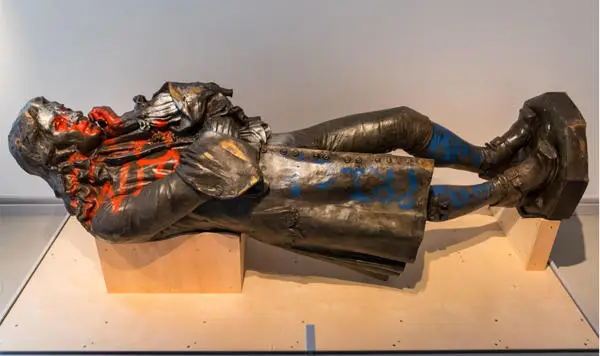
In the UK, by the summer of 2020, the Black Lives Matter movement was intensified by the inequalities revealed by the Covid-19 pandemic2 and there were largely peaceful demonstrations and protests in many cities. The toppling of the Edward Colston statue by demonstrators and its dumping into the St Augustine's Reach of Bristol Harbour, led to the indictment of four people accused of criminal damage to the effigy, later to be acquitted by the trial jury.3 The statue was then recovered from the harbour, the graffiti daubed on it stabilised in a conservation process and temporarily displayed in a supine position at Bristol’s M-Shed Museum.
Clearly alarmed by events in the US and England, in 2021 the UK’s Conservative Government went much further than the Trump administration in not only increasing the criminal penalties for anyone who attacks a public monument (to the same ten years) but eventually prevented local authorities, or what they would call ‘heritage custodians’, from removing statues from their present siting. In January of the same year, Robert Jenrick MP, then UK Communities Secretary, wrote in The Telegraph, using rhetoric echoing US President Trump, that he was waging war on ‘town hall militants and woke worthies’ who have ‘written a single, often negative narrative’ about ‘our history’. He said new legislation would shortly be announced to protect statues from being removed ‘on a whim or at the behest of a baying mob’.4 Mr Jenrick then stated, , that new ‘legislation’ would be passed by the UK Parliament that would ‘require individuals to have listed building consent or planning permission before removing any historic statue.’ This time there was actually no Act of Parliament, yet this so-called ‘law’, reported the Art Newspaper5, would come into effect from March of that year and apply to England's estimated 12,000 existing historic public statues.
The City of London Corporation’s political Members had previously voted in January 2021 to remove two statues in its medieval Guildhall6: likenesses of John Cass7 a director of the Royal African Company and William Beckford8, who enslaved Africans in Jamaica. However, this decision to remove the statues was reversed in October of the same year9 after the Government’s announcement of its Retain and Explain policy and the City then embarked upon a reinterpretation project that would involve the attachment of explanatory plaques to the statues along with online resources.10 Similarly, the Guy’s and St Thomas’ Hospital Foundation, which had also previously intended to remove a statue of its benefactors Thomas Guy and Robert Clayton, reversed its decision to remove the statues and, like the City of London, is placing explanatory plaques in front of the effigies.11
In 2022, the ‘Criminal Damage to Memorials: Police, Crime, Sentencing and Courts Act’ was enacted by the UK Parliament.12 The legislation increased the maximum penalty for criminal damage to a memorial from less than £5,000 and three months’ imprisonment, to ten years’. The Labour Party’s then Shadow Justice Secretary, David Lammy MP, commented at the time that the ‘New crime bill makes protecting statues more important than punishing rape'13. Shortly afterwards, there was another announcement of an initiative, variously described as a ‘policy’ and ‘law’, to be called ‘Retain and Explain’. This is a political stance that has become a key response of the UK’s former Conservative government’s attacks on those who depart from their version of traditional values, the so-called ‘culture wars’14 whose bellicose title is not just metaphorical but, as we have seen in the US, can result in deadly social conflict.
Shortly after Mr Jenrick’s announcement, the UK Government said it would publish ‘guidance’ which eventually appeared in October 202315 in a joint press statement by then Culture Secretary Lucy Fraser KC MP, Culture Minister Lord Parkinson and Historic England. The statement said the guidance, also referred to as a ‘toolkit’, would contain a number of case studies, intended to ‘advise custodians facing calls for the removal of heritage assets in their care or ownership.’ Since then, a number of local authorities and heritage organisations, some that previously wanted to remove contested colonial statuary, have reversed their decisions. They have had to acquiesce to the government’s Retain and Explain policy with reinterpretation projects at various stages of completion.
This sequence of events not only represents an intensifying public disagreement with the custodians of colonial statuary; it also reveals a veritable panic on the part of politicians and legislators to contain and neutralise a conflict about the cultural values espoused by heritage custodians. Furthermore, one can detect a confluence between politico-legal strategies and rhetoric deployed in the USA and in the UK. The Black Lives Matter movement, especially from the year 2020 after the murder of George Floyd, represented not only a rare instance of global protest, it also was remarkable in the way that conflict about police brutality morphed into concerns about contested heritage and public statuary.
These conflicts around contested heritage are really about value, a rapidly shifting and evolving set of cultural and social norms that are at variance with those that existed when these monuments were first erected and they challenge an anachronistic cult of monumentality. As such, the attacks on contested statues are highly symbolic acts of iconoclasm, that re-enact colonial violence designed to draw attention to specific historical circumstances. It could also be argued that our present-day symbolic activism about monumental statues arises from what the psychoanalyst C G Jung might have termed a ‘collective unconscious’16 . This is the deeply buried memory of events and archetypes in our psyche handed down through generations – not through conscious speech or writing but informed by a structure of feeling of ancestral histories not seen or directly experienced, yet intensely felt in the present.
I would also argue that the UK’s current Retain and Explain policy, which takes the form of ‘interpretations’ that highlight the human rights violations of persons depicted in monuments associated with empire, colonialism and enslavement may only serve to intensify pressures on states to remove them. The policy may also, in practice, only serve to emphasise moral and ethical questions in relation to contested heritage – especially as the ‘explain’ and physical monument remain in the control of the heritage custodian having the ultimate right of veto. If a person commemorated in a statue has committed wrongdoing or crimes against humanity that need to be identified and enumerated on plaques or other explanatory resources, such devices not only draw attention to persons unworthy of our admiration, but they serve to emphasise questions about why the monument is there in the first place. As cultural critic Nathaniel Adam Tobias Coleman, has powerfully argued:
"There seems to be both a conservative and a revisionist 'Back to Plaque' argument… we need to stop being so reliant on a little piece of writing that sits like a stain on a rotting tooth… plaques don't solve the problem. And our problem is, and always has been, the pedestal in public space. No amount of contextualisation will detract from glorification. The unequal relationship between a statue on high, looming over us, who labour under it, down below, cannot be critically analysed by the mere addition of a plaque, postcolonial or no, that leaves the unequal relationship intact".17
This trenchant critique should serve as a warning to heritage custodians. The current trend of affixing plaques to contested statues, partly recommended by the case studies in the UK government’s Retain and Explain published guidance, is unlikely, in the long-term, to allay demands for a more fundamental reckoning with colonial monumentality. Furthermore, these recent conflicts and disagreements about public statuary, not only coincide with demands for the return of looted cultural property held by European and American museums, there is also the ongoing demand for reparations by institutions and nation states which have profited from the enslavement of Africans. It may only be a matter of time before all of these issues coalesce.
Guest blogs feature voices on topics relevant to our collections and public spaces. Guest blogs do not necessarily reflect the views of the City Corporation.
1Nora Neus (2023) Robert E Lee statue that sparked Charlottesville riot is melted down: ‘Like his face was crying’. The Guardian, 26 October.
2 Katherine Viner (2020) Interview: ‘Naomi Klein: We must not return to the pre-Covid status quo, only worse'. The Guardian, 13 July.
3 Damien Gayle (2022) ‘Colston Four acquittal to be referred to court of appeal.’ The Guardian, 13 April.
4 Robert Jenrick (2021) ‘We will save Britain's statues from the woke militants who want to censor our past.’ The Telegraph, 16 January.
5 Gareth Harris (2021) ‘UK government announces new laws to protect controversial historic monuments from 'woke worthies and baying mobs'’. Art Newspaper, 12 January.
6 BBC News (2021) ‘City of London statues removed over 'slavery link'. BBC News, 21 January.
7 Madge Dresser (2007) ‘Set in stone? statues and slavery in London’, History Workshop Journal,64(1): 162–199.
8 Perry Gauci (2013) William Beckford first prime minister of the London Empire. New Haven, CT: Yale University Press.
9 City of London Corporation (2021) ‘City statues with links to slavery to be retained and contextualised.’ Press Release, 7 October.
10 Jack Mendel (2023) ‘City of London Corporation will ‘explain and retain’ two slave owner statues with plaques.’ City AM, 7 July.
11 James Twomey (2023) ‘Guy’s and St Thomas’ statue to stay put after plans to move it over slavery links.’ South London Press, 10 January.
12 Home Office (2021) ‘Criminal Damage to Memorials: Police, Crime, Sentencing and Courts Act. ’Policy Paper, Updated August 2022.
13 Sky News (2021) ‘New crime bill 'makes protecting statues more important than punishing rape', says Labour’. Sky News, 17 March.
14 Bobby Duffy, Kirstie Hewlett, George Murkin, Rebecca Benson, Rachel Hesketh, Ben Page, Gideon Skinner and Glenn Gottfried (2021) ‘Culture Wars in the UK’. The Policy Institute, King’s College London.
15 Rt Hon Lucy Frazer KC MP, and Lord Parkinson of Whitley Bay (2023) ‘Press release: ‘Retain and explain’ guidance published to protect historic statues.’ Department for Digital, Culture, Media and Sport and Historic England, 5 October.
16 C G Jung (1969) The archetypes and the collective unconscious. Bollingen Series XX. Collected Works of C G Jung. Vol 9, Part 1. Eds and Tr. Gerhard Adler and R F C Hull. Princeton, NJ: Princeton University Press.
17 Nathaniel Adam Tobias Coleman (2021) ‘Britain’s #BLM Statue, Podcast Series, Episode 2: Back to Plaque?’ Henry Moore Foundation, September 2021 – January 2022.