Sam's interview
1. Why did you want to be involved in this photo shoot?
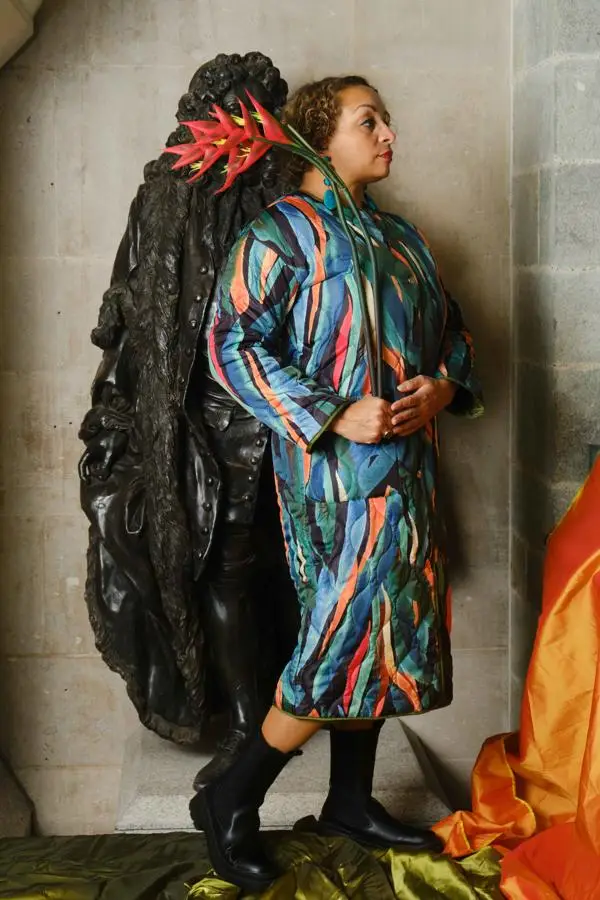
I am the Project Manager on the Revealing the City’s Past project and it was important to have that moment of reckoning with both of the statues, to personally confront them for their horrific misdeeds.
2. How did it make you feel to be involved in this photoshoot?
I had a really strange mix of emotions. I was the Shoot Director but also a participant. I have been in the Guildhall complex many times but to get up close to these two statues who profited through the violent enslavement, oppression and murder of my ancestors was a very important moment for me. Confronting them felt very loaded as these two despicable characters, lauded for centuries as great men, as ‘philanthropists’, are emblematic of the problem that British society has in acknowledging how the wealth of this country was founded off the inhumane enslavement and oppression of the British Empire and its colonial mission.
Unpicking that shame is avoided and their behaviour, along with so many others, has been excused, whitewashed and justified which has made it all the more painful for the survivors of colonialism. Most of the general public are oblivious of the extent to which the actions of these and others has shaped the reality we now live in; where racism and discrimination is rife and the wealth disparity in the country is growing. We even see the ripple effect of how settler colonialism is justified by British politicians and the press when considering the senseless genocide happening right now, in Gaza. It’s inhumane.
3. What would you have liked to have said to Beckford and Cass or those who facilitated their involvement in enslaving Africans if you could have done so when they were alive?
I don’t know; where would you start? I see them for what they were; vile tools of oppression and bloody extraction but I have no interest in them as individuals. I cannot ignore what they have done as it is also part of my history and my reality but I would choose not to give them anymore space or airtime than they have been given in central spaces of prominence in places like the Guildhall, for hundreds of years.
I don’t think that these men have any purpose or place in the glowing future of African and Caribbean people. Both men created so much damage in their abhorrent greed to profit from other human beings.
Rather than talking to them, I find that I am much more interested in reaching out to and learning more about the depth and breadth of the ingenuity, mastery, strength and determination of African people and their Caribbean descendants, like my father. My ancestors rose up, despite what these appalling individuals did to them. For that, I am so proud. That strength and determination is intrinsic to who we are and who I am as a person. That will never be taken from us.
4. Tell us about your outfit and the significance of the props that you used?
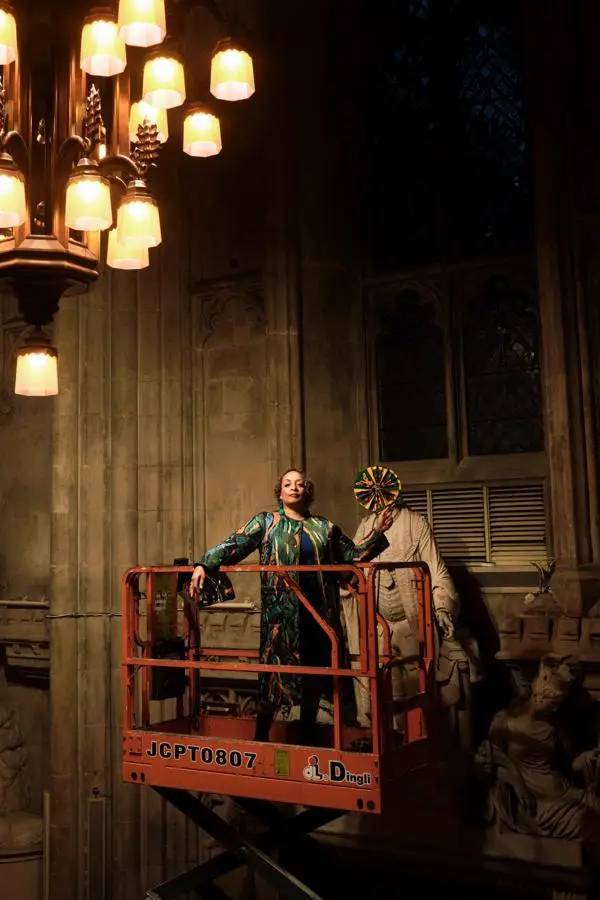
I brought with me a Ghanaian fan, a leopard print scarf and two red Heliconia. They are all important symbols of who I am and what I wanted to convey in this shoot.
My Caribbean ancestry derives from West Africa. I am drawn to the Adinkra symbols from Ghana that are often found on clothing and fabrics. The fan immediately reminded me of the Adinkra symbols that hold so much power, for example, the Obaa Pa is the symbol for the ideal woman for the Akan people of Ghana. There women are revered for their independence, strength and caring, loving nature. I can really identify with that, all traits I embody and notice in other African and Caribbean women. I wanted to celebrate these feminine West African traits in the main hall at the Guildhall which is such a Eurocentric patriarchal space, where women are portrayed as largely subservient and decorative.
The scarf is something I’ve had for years. It is bright and bold like me and I love animal print because it refuses to be diminished. I wanted my pieces to eclipse the muted tones of these statues. Their horrendous misdeeds are a very painful part of our history but the joy, vibrancy and beauty of the Caribbean and African diaspora communities is so central to our culture and belief systems that cannot be diminished by the long shadow the statues have caste over our history.
Lastly, the red Heliconia is the national flower of Montserrat, which grows wild in the Silver Hills of this tiny volcanic island in the Lesser Antilles, where my father was born and raised. Dad was part of the Windrush generation that came to Britain and was treated appallingly by the British. Again, their determination, resistance and strength meant that they managed to create lives here for themselves in the face of so much adversity. When we talk of resistance and power against enslavement, we are often drawn to think about this from a Jamaican perspective. It was really important to me to bring a reminder to this shoot of the might and force of the other enslaved Africans who were sold onto the other Caribbean islands by the British and other European colonial powers and who also rose up against that oppression.
Montserrat has long been a powerful symbol of resistance in many different ways so I wanted to bring my father’s memory, his strength and power into the space. The Heliconia eclipses everything that is around it. Like my memories of my father and my proud Montserratian heritage, they diminish the dull and muted statues behind them and bring that vibrancy, joy and light of the Caribbean into the foreground.
5. The Revealing the City's Past project is about reinterpreting these two statues in light of the fact that they are not being removed under the Government's 'retain and explain' directive. Do you think projects like this are important to you?
Yes, they are incredibly important, if done well, as they provide an opportunity to re-educate British people on the real history of empire and British colonialism that our formal education mostly glosses over. This is an opportunity to engage people in a sincere accountability for how Britain became so wealthy, instead of the curated narrative of Great British pride we are mistaught in schools and universities. The key to this is doing this well and understanding what that means – is the City willing to relinquish its power and allow us to uncover its misdeeds and reinterpret its spaces on our terms?
The ‘retain and explain’ policy does not go far enough to really understand and connect with the history behind these hideous characters whose appalling misdeeds have been sanitised for the benefit of the wealthy few, perpetuating a system that lacks justice for the many. It is not the solution, these statues should not still be in here.
6. What do you hope the City of London Corporation does next to make their spaces more relevant and accessible to more people?
The City of London has a huge responsibility to unpick and understand how to navigate this bloody stain of history and the shameful shadow that they continue to cast today. This project must only be the start of that process.
In their current positions, these statues are still in prominent places as symbols of pride and until now have never been portrayed in any other light. These are also spaces that are most often patronised by the wealthy and the elite of British society – what does that say about them and their concerns?
Taking down these statues from the Guildhall is the only appropriate action. The reinterpretation from this project will allow those who want to access these statues in a museum or somewhere less prominent in the complex, to be utilised as a place of learning and reflection about British colonial history.
I would also like the City of London to continue to do this with all of the statues in the Guildhall. I’d particularly like them to reinterpret the statue of Winston Churchill - another historical character whose legacy has been bleached clean to perpetuate the Great British narrative.
Guest interviews feature voices on topics relevant to our collections and public spaces. Guest interviews do not necessarily reflect the views of the City Corporation
Artwork ©Ayanna Sankara